

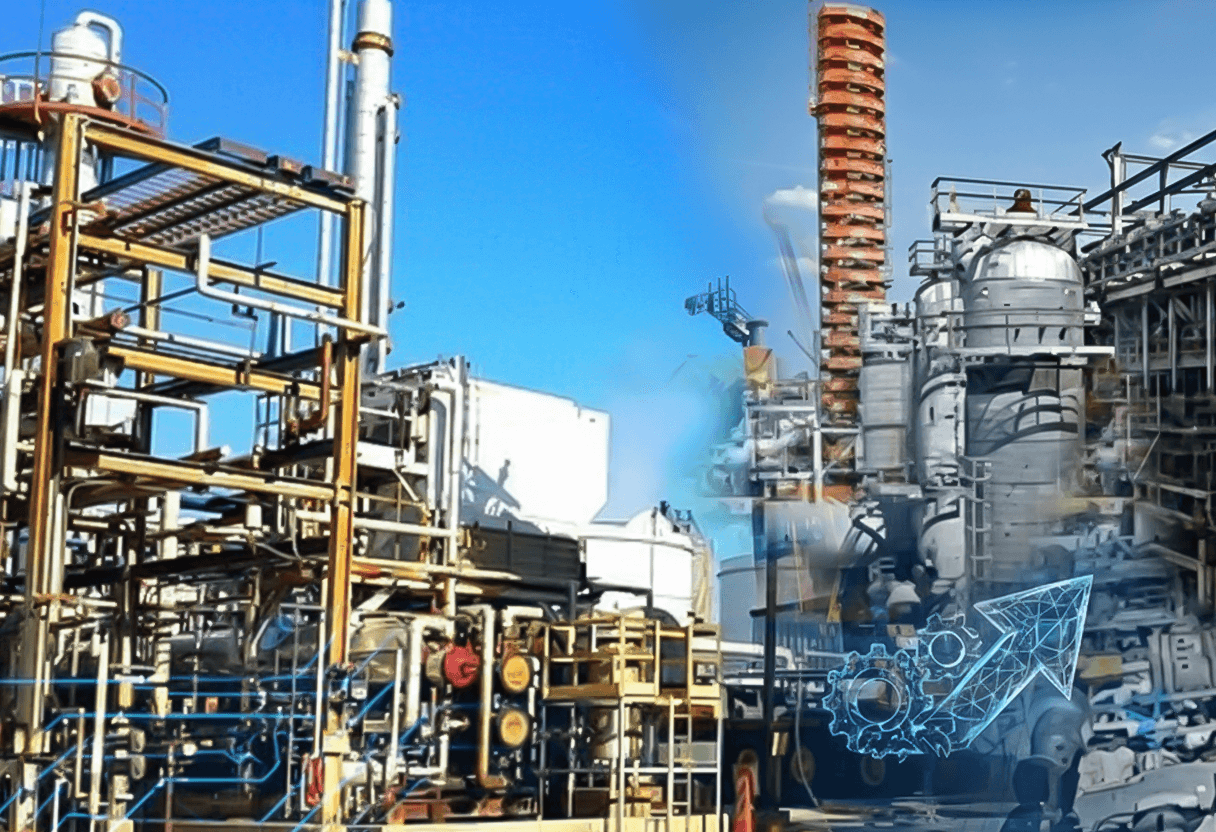
SHUTDOWN & TURNAROUND SERVICES
Shutdown & Turnaround execution represents the most demanding domain in industrial maintenance—where entire facilities are temporarily halted for deep inspection, overhaul, replacement and restoration of critical assets. In high-risk, high-value environments such as offshore rigs and LNG terminals, shutdown performance directly influences operational safety, production continuity and commercial competitiveness. These facilities run under extreme thermal exposure, cryogenic temperature cycles, corrosive atmospheres, high pressure ratings and hazardous materials handling. Therefore, shutdowns require meticulous planning, multi-discipline coordination and flawless time management.
On offshore rigs, a shutdown window is the only opportunity to intervene on hydrocarbon processing systems, rotating equipment, turbine assemblies, wellhead infrastructure, high-pressure separators, flare units, heat exchangers and safety-critical pumps. Every task must be sequenced through job safety analysis (JSA), permit-to-work protocols, confined-space strategies and simultaneous operations (SIMOPS) governance. A single scheduling error can trigger production loss or asset risk; therefore, shutdown success is measured by zero safety incidents, zero scope deviation and full recommissioning within the target window.
LNG terminals add a second layer of complexity: cryogenic materials handling and large-capacity vaporisation systems leave no room for error during shutdown execution. Work may involve inspection of LNG loading arms, vapour return systems, boil-off gas compressors, submersible pumps, cryogenic pipelines, condensate recovery units and tank farm auxiliary systems. All activities require precision sequencing, NDT compliance, line isolation verification, and pressure/temperature equalisation procedures to prepare the facility for recommissioning. The overarching goal of turnaround management is not merely restoration of asset performance, but engineered performance improvement that extends the service life of critical infrastructure far beyond the upcoming production cycle.
Industrial Shutdowns
“Time-Bound Overhauls with Total Operational Restoration”
Industrial shutdowns are structured around a predefined work breakdown schedule where every task is planned, resourced and executed with millimetre-level precision. Critical activities include degassing, mechanical dismantling, vessel opening, tube bundle extraction, NDT inspection, seal and gasket replacement, alignment and calibration, asset cleaning, material upgrades and torque-controlled reassembly. Hydraulic tests, electrical logic tests and full operational checks ensure safe and complete restoration before handover.
Oil & Gas Shutdown Support
“Safe High-Risk Turnarounds under Regulatory and Process Control”
In hydrocarbon facilities, shutdown campaigns cover pressure vessels, piping spools, rotating equipment, compressors, loading systems, booster pumps, turbine skids, firewater systems, relief valves and pipeline tie-ins. Every step follows ATEX, IECEx, API, NFPA and IMO compliance frameworks. Personnel supervision, gas monitoring, field isolation planning, permit-to-work auditing and continuous HSE oversight provide a secure execution environment, even under extreme operational and weather exposure conditions.
Power & Utility Shutdown Execution
“Rapid-Cycle Maintenance for Large-Scale Generation Assets”
Shutdowns in power-generation and utility-grade networks ensure complete performance restoration of boilers, fuel handling systems, turbines, condensers, cooling water pumps, auxiliary motors, MCCs, transformers and switchyards. The turnaround methodology prioritises minimal outage duration through parallel crew deployment, multi-discipline execution and immediate decision-making authority on-site. The end objective is swift resumption of generation output without performance loss or unstable load parameters.
Emergency Shutdown & Restart
“Fast-Track System Recovery with Zero-Defect Recommissioning”
Emergency shutdowns activate in response to unexpected disruption, turbulence detection or sudden operational threat. The scope includes emergency isolation, fault diagnostics, corrective maintenance, component replacement, safety logic validation, interlock loop testing and sequential restart under controlled observation. Restarting is conducted using real-time performance verification to prevent secondary failure and guarantee full production safety before the process is released back to live operation.